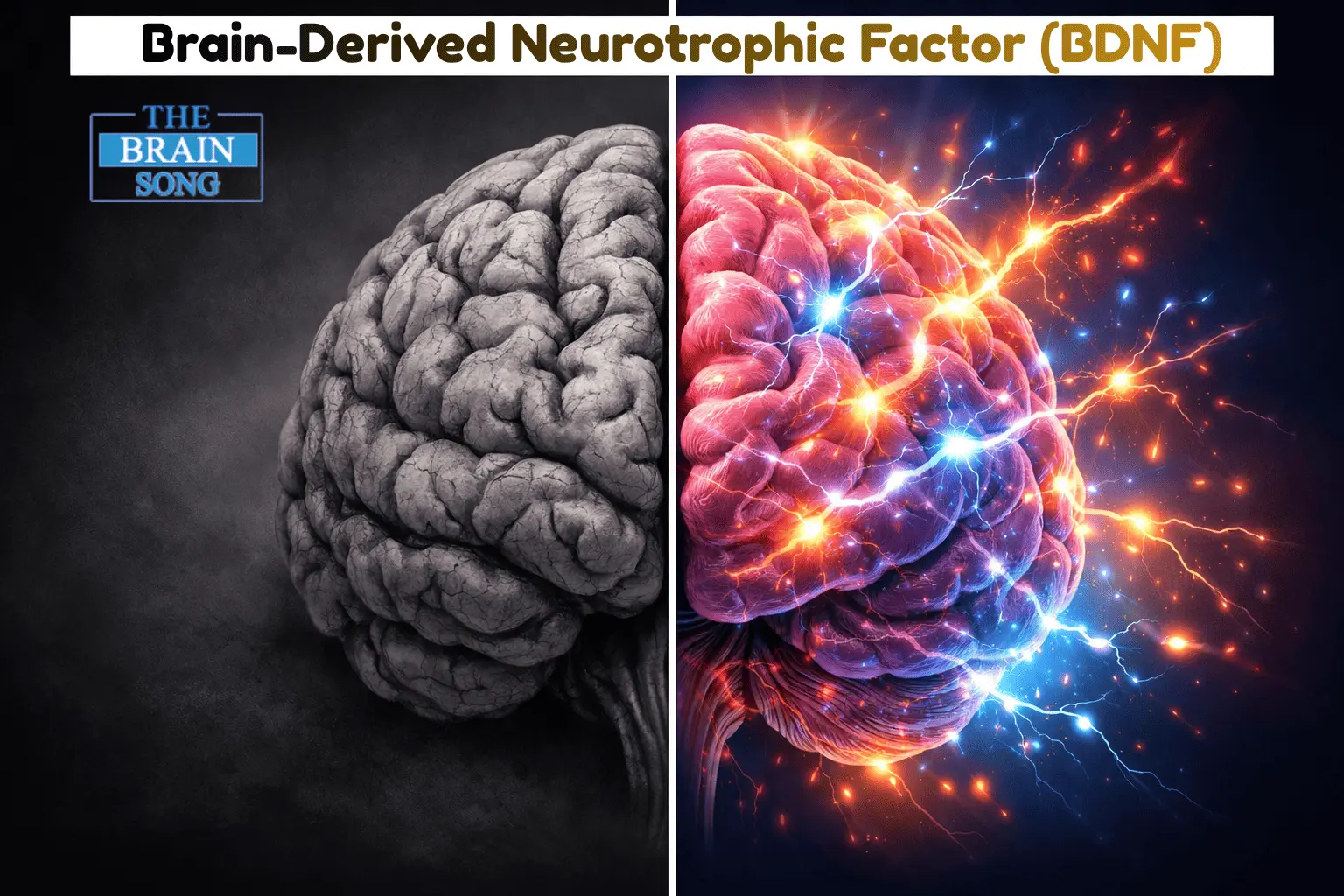
There's a molecule in your brain that neuroscientists describe, almost universally, as one of the most important discoveries in modern brain science. It doesn't get the headlines that dopamine or serotonin do — but increasingly, researchers believe it may matter more for long-term cognitive health than either of those better-known chemicals.
Its name is BDNF: Brain-Derived Neurotrophic Factor. And if you care about staying sharp as you age, learning new things efficiently, or simply keeping your brain working at its best — understanding BDNF is worth your time.
BDNF is a protein produced naturally in the brain that supports the survival, growth, and functioning of neurons. Neuroscientists often call it "fertilizer for the brain" because of how it nourishes neural connections — much like fertilizer supports plant growth. Higher BDNF levels are consistently associated with sharper memory, better learning, and greater mental resilience.
What BDNF Actually Does Inside Your Brain
To understand BDNF, it helps to think about what neurons actually need to do their job. A neuron isn't just a passive wire. It actively responds to signals, forms new connections, strengthens existing ones, and sometimes prunes connections that aren't being used. All of that activity requires biological support — and BDNF is one of the central proteins that provides it.
More specifically, BDNF does several things that directly affect how well your brain works:
- Promotes neuroplasticity — the brain's ability to rewire itself in response to experience, learning, and recovery
- Supports long-term potentiation (LTP) — the cellular process underlying memory formation
- Protects neurons from stress and damage — acting as a kind of biological buffer for cells under pressure
- Encourages the growth of new neural connections — expanding the brain's communication network
- Influences mood and stress regulation — BDNF receptors are abundant in areas tied to emotional processing
Put simply: BDNF is the infrastructure protein for a well-functioning brain. When levels are healthy, learning is easier, memory is more reliable, and the brain is more resilient to mental fatigue and stress.
Why BDNF Declines — and Why That Matters
Here's the uncomfortable reality: BDNF levels tend to decrease naturally as we age. And several common lifestyle factors accelerate that decline.
Factors that reduce BDNF:
- Chronic stress and elevated cortisol
- Poor sleep quality or sleep deprivation
- Sedentary lifestyle with minimal physical activity
- High-sugar, ultra-processed diets
- Social isolation and lack of cognitive stimulation
- Chronic inflammation
This isn't just about feeling mentally sluggish. Research has consistently linked lower BDNF levels with impaired memory function, reduced cognitive flexibility, and greater vulnerability to neurological decline over time.
BDNF decline isn't inevitable or irreversible. Neuroscience research has identified multiple interventions — from exercise to specific sound-based protocols — that can support healthy BDNF activity. The brain remains plastic throughout life. That's the good news.
The BDNF–Gamma Brainwave Connection
This is where things get genuinely interesting — and where The Brain Song enters the picture.
Gamma brainwaves are the fastest electrical oscillations the brain produces, typically running at 30 to 100 Hz. For years, researchers somewhat overlooked Gamma compared to better-studied states like Alpha (relaxation) and Theta (deep meditation). But more recent research has brought Gamma to the front of neuroscience conversations.
Studies from institutions including MIT have investigated the relationship between Gamma oscillations and BDNF. The emerging picture is that Gamma brainwave activity may play a role in triggering the cellular mechanisms that promote BDNF production — particularly in the hippocampus, the brain's core memory and learning hub.
What makes this practically significant is that brainwave entrainment — the phenomenon where the brain tends to synchronize its electrical activity with external rhythmic stimuli — offers a non-invasive, accessible way to encourage Gamma states. This is what The Brain Song is designed around: using precisely engineered audio patterns to guide the brain toward Gamma frequencies, with the goal of supporting the conditions under which BDNF activity is most likely to occur.
How brainwave entrainment works:
- The brain produces electrical oscillations at various frequencies depending on state (sleep, focus, relaxation, etc.)
- External rhythmic stimuli — such as specific audio patterns — can encourage the brain's electrical activity to shift toward matching that frequency (the "frequency following response")
- Consistent exposure to Gamma-range audio stimulation may help establish and reinforce Gamma brainwave patterns
- Research suggests these Gamma patterns may create favorable conditions for BDNF activity in key brain regions
Ways to Naturally Support BDNF
The evidence base for BDNF support has grown significantly in recent years. Here's what the research currently identifies as effective BDNF-supporting strategies:
- Aerobic exercise — One of the most well-documented BDNF boosters. Even moderate-intensity cardio (brisk walking, cycling) shows meaningful effects in multiple studies
- Quality sleep — Deep sleep stages are particularly associated with BDNF production; sleep deprivation is strongly linked to BDNF suppression
- Intermittent fasting — Some research indicates that controlled caloric restriction may upregulate BDNF pathways
- Novel cognitive stimulation — Learning new skills, languages, or musical instruments appears to drive BDNF in learning-associated brain regions
- Omega-3 fatty acids (DHA) — Associated with BDNF in some dietary studies, particularly from fatty fish consumption
- Gamma brainwave entrainment (sound-based) — An emerging and increasingly studied approach, particularly relevant to the type of audio science behind The Brain Song
Give Your Brain the BDNF Support It Deserves
The Brain Song is a 12-minute daily audio engineered to guide your brain toward Gamma brainwave frequencies — supporting the natural conditions linked with BDNF activity. Just headphones. Just 12 minutes a day.
🎧 Try The Brain Song Risk-Free →$39 one-time · 90-day money-back guarantee · Instant digital delivery
Why Most People Have Never Heard of BDNF
It's a fair question. Dopamine is everywhere in popular culture — productivity podcasters talk about dopamine fasts, social media coverage of dopamine reward loops is inescapable. Serotonin gets most of the attention in mental health discussions. So why hasn't BDNF broken through to mainstream consciousness?
Part of the answer is timing. While BDNF was identified in 1982, the research connecting it to cognitive performance, memory, and brainwave patterns has really accelerated in the last decade. The science is still building, and translation from neuroscience journals to general health awareness takes time.
The other part is that BDNF doesn't produce a quick, noticeable "hit" the way dopamine does. Its effects are cumulative, structural, and long-term — which makes them real but harder to perceive in the moment. This is actually typical of the most important biological processes: they work quietly, consistently, and their absence is felt more acutely than their presence.
The Bottom Line on BDNF
BDNF is arguably the most important molecule in your brain that most people have never thought about. It underlies your capacity to learn, to remember, to recover from mental stress, and to maintain cognitive sharpness across a lifetime.
The main reason BDNF matters so much is that it's not fixed — it responds to what you do, how you sleep, how you manage stress, and now, increasingly, to specific sound-based protocols designed to activate the brainwave states most closely associated with its production.
The most effective approach to supporting BDNF isn't a single magic bullet but a combination of the basics — sleep, movement, stimulation — layered with tools like The Brain Song that target the neurological mechanisms directly.